 Skip to content
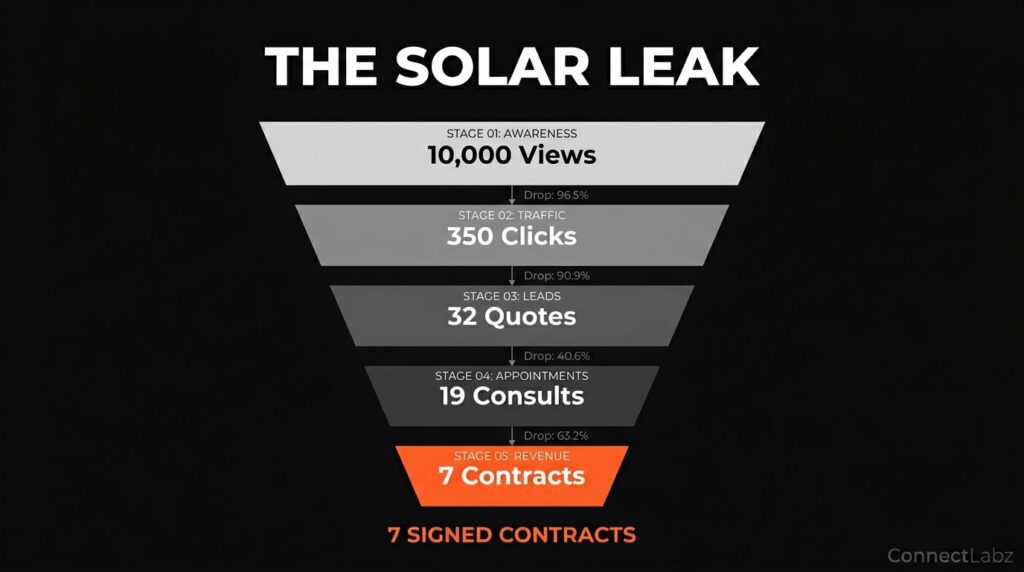
Every solar company runs the exact same customer journey. Most of them leak revenue at every single stage. Typically, 10,000 ad impressions become 350 clicks, 32 quote requests, 19 consults, and 7 signed contracts. Fix any one of these stages and you double your pipeline without touching your ad spend. Here is the math behind your funnel and how to plug the holes.
Key Takeaways
- 10,000 ad views become roughly 7 signed contracts. The big drops happen at the click, quote, and consult stages.
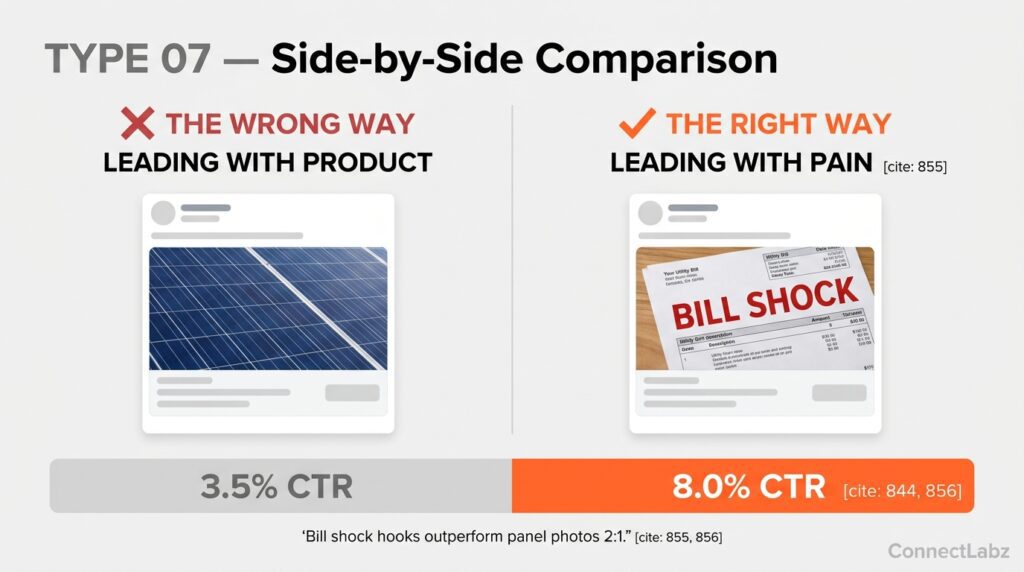
- Strong bill savings hooks lift your click-through rate from 3.5 percent to 6 or 8 percent without raising your budget.
- Baymard Institute research shows most websites lose 40 percent of traffic to friction within the first 5 seconds.
- Your consult show-rate jumps 25 to 40 percent with a simple day-before reminder text and a morning-of outreach call.
- Your contract close rate lifts 30 percent when proposals clearly show savings math and financing options side by side.
Download the Blueprint
See every stage mapped with real numbers, ad formats, and exact fixes in the Solar Growth Blueprint. Download it free.
Why the Funnel Math Matters
A leaky funnel means you are paying to generate leads that never had a real chance to close. Homeowners fall out of the journey not because they lose interest in solar, but because the next step is too confusing, too slow, or lacks trust. Fixing these leaks is structurally cheaper than buying more traffic.
Top of Funnel: Traffic & Ads
Stage 1: Sees Your Ad (10,000 homeowners)
Meta’s creative guidance says the first 2 to 3 seconds decide the success of the ad. Weak hooks lose 90 percent of your audience right here. Leading with a picture of a solar panel instead of an electric bill is the most common mistake we see.
Fix: Open every ad with a utility bill shock, a meter running backwards, or a neighbor’s savings number.
Stage 2: Clicks to Site (350 clicks, 3.5 percent)
Strong hooks push your click-through rate up to 6 or 8 percent. That is roughly double the traffic at the exact same ad spend.
Fix: Test 10 to 20 hook variations a month. Kill anything below a 4 percent CTR. Send each ad to a dedicated landing page.
Middle & Bottom of Funnel: Conversion
Stage 3: Browses the Site (210 browsers, 60 percent of clicks)
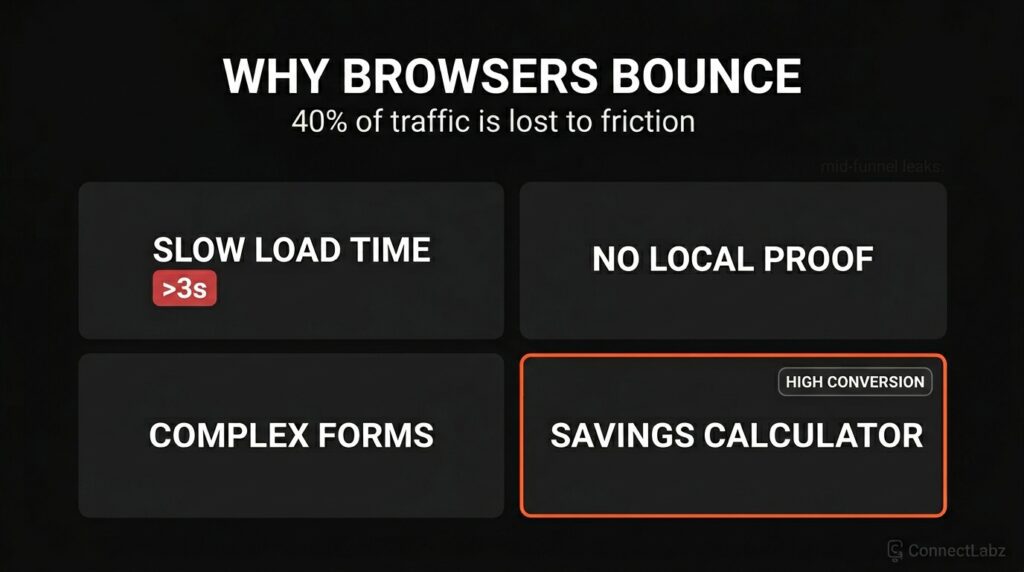
Forty percent of your clicks will bounce immediately. Google’s PageSpeed Insights shows that mobile pages slower than 3 seconds lose most of their traffic. No local proof, no pricing, and slow load times drive the rest away.
Fix: Fix your Core Web Vitals, put install photos from the same city on the page, and show at least directional pricing.
Stage 4: Requests a Quote (32 requests, 15 percent of browsers)
Without a savings calculator, a clear call-to-action, and trust signals, most browsers leave without giving you a chance. This is the single most expensive drop in the funnel.
Fix: Add a one-field savings calculator that estimates bill savings after a zip code entry, then seamlessly hand them off to a form.
Stage 5: Shows for Consult (19 shows, 60 percent of requests)
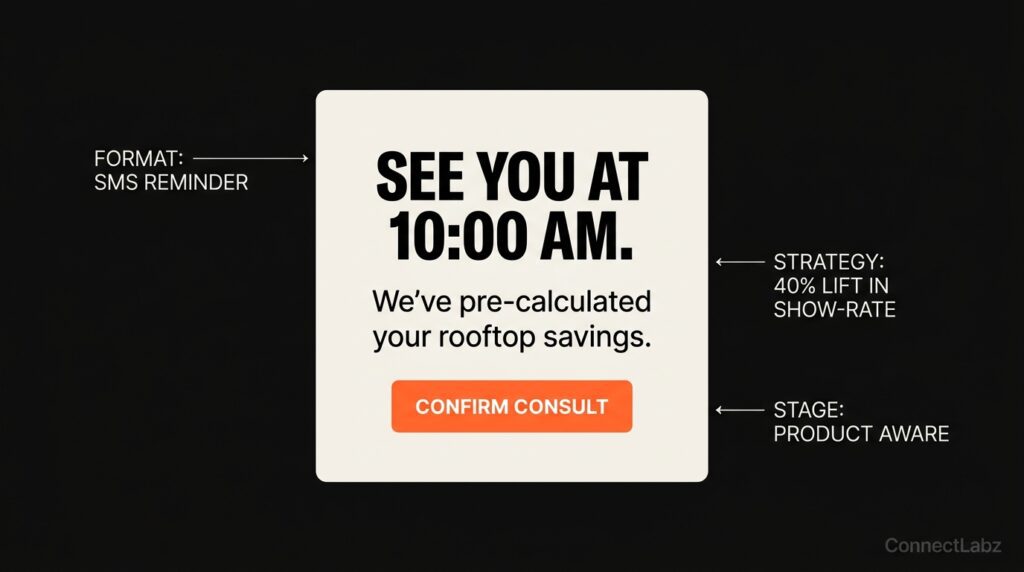
No reminders, no pre-consult education, and no urgency. Texted reminders alone lift your show-rate by 25 to 40 percent.
Fix: Send a confirmation text right away, a day-before reminder, and a morning-of outreach call.
Stage 6: Signs Contract (7 contracts, 37 percent of consults)
Proposal confusion is the final killer. Homeowners need 20 year savings numbers, financing options, and a visual roof layout on one page or they will shop around.
Fix: Use a branded proposal tool that shows savings math, financing side by side, and a clear timeline.
See Your Own Funnel Math
The numbers above are industry medians. Yours will be different. Plug your monthly ad spend, click-through rate, lead volume, and average install value into our free marketing KPI calculator. It runs the same six-stage math and shows you, in dollars, which stage is leaking the most contracts right now in your own pipeline. Then you know exactly where to spend your fixing budget first.
Frequently Asked Questions
Where do solar companies lose the most leads?
The biggest drop is from browsers to quote requests. Most sites lose 85 percent of browsers because they have no savings calculator and no clear call to action.
How much does fixing one stage of the funnel improve pipeline?
A 2x improvement at any one stage roughly doubles your signed contracts, because the funnel compounds. Most solar companies have at least three stages worth fixing.
Why does response time matter if the lead already filled a form?
Because the lead is also talking to your competitors. HBR’s research found that a 5-minute follow-up is 21 times more likely to qualify the lead than a 30-minute wait.
Conclusion
10,000 ad views to 7 contracts is the solar industry default, and it is not a traffic problem. It is a leak problem at five specific stages, and every leak is a known one. Start with the biggest drop in your own pipeline — usually the browse-to-quote stage — and work backward to the ad creative. Each fix compounds the next, and the same ad spend you are running today starts producing twice the installs.
You know the journey now. What you probably do not know is exactly where your own company is leaking. A free personalized audit measures each stage against these benchmarks, shows the biggest gap, and estimates the revenue sitting in that one fix.
Get Your Free Personalized Audit

