 Skip to content
By the ConnectLabz team — we build lead-response automation, AI calling, and nurture systems that stop small businesses from losing the leads they already paid for. Updated June 2026.
Open your CRM right now. You’ll probably find them — leads that went cold while you were busy running the business. Someone filled out a form on Tuesday. Nobody replied until Thursday. By then they’d booked with whoever answered first. You paid for that lead. You just never closed it. That quiet bleed is what most owners come to a marketing automation agency to stop.
But most of them think the fix is a bigger software platform. It usually isn’t. The real fix is deciding what to automate, in what order, and then making the follow-up actually happen. So before you buy another tool, look at how the work breaks down: what these agencies do, what to automate first, and what it costs in 2026.
Key Takeaways
- A marketing automation agency builds and runs the systems behind your follow-up — lead capture, routing, nurture, scoring, and reporting. The good ones design the system; the weak ones just resell you a login.
- Automate in order of proximity to revenue — what we call the Closest-to-Cash Order. Instant lead response is step one, every time.
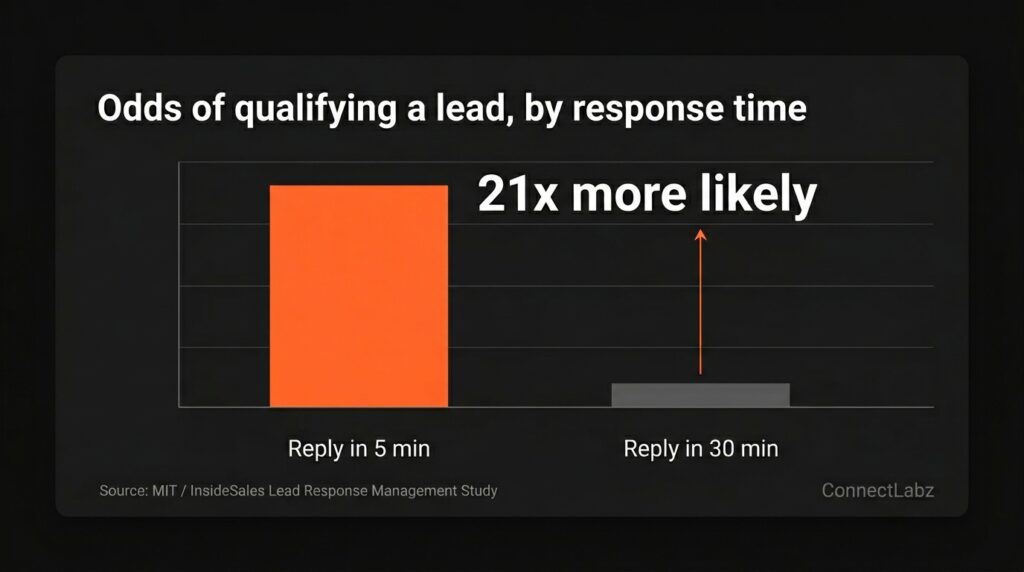
- Speed is the whole game: a lead answered in 5 minutes is ~21x more likely to qualify than one answered at 30 (MIT/InsideSales study).
- More software hasn’t fixed this. 63.5% of companies never respond to a lead at all (RevenueHero, 2024) — up from 23% in 2011. It’s a process-and-speed problem, not a tooling gap.
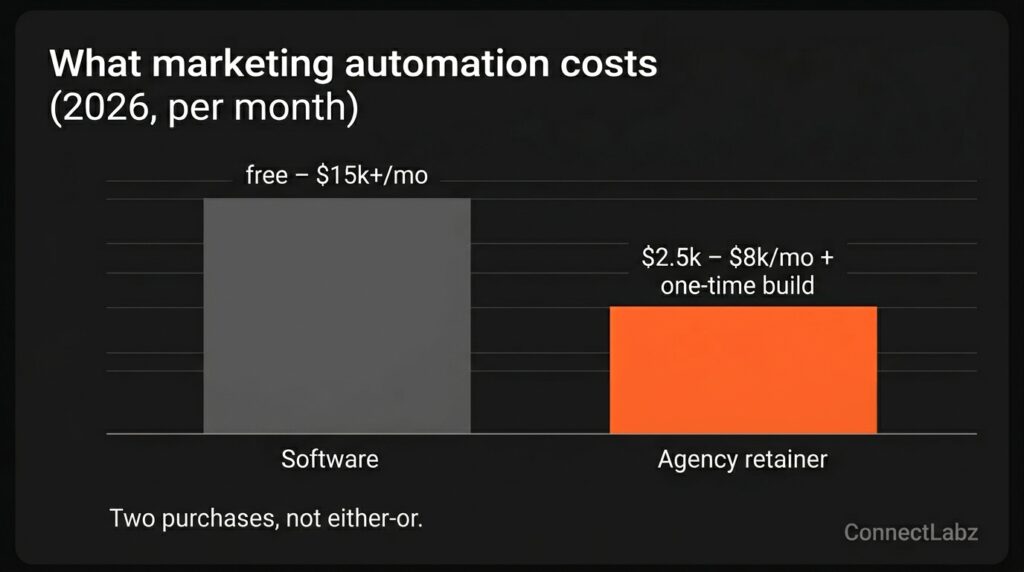
- 2026 costs, and they’re separate things: software runs free to $15,000+/month; agency retainers commonly land $2,500–$8,000/month plus a one-time build. (Directional — your stack and scope move it.)
What does a marketing automation agency do?
A marketing automation agency designs, builds, and manages the systems that handle your follow-up automatically. That covers lead capture and routing, CRM updates, behaviour-triggered nurture, lead scoring, sales handoff, and reporting. Put simply, marketing automation is software-run follow-up: the right message firing at the right moment, without someone remembering to press send. The good agencies work like systems designers, not button-pushers. Their focus is what happens after the leads arrive.
That last part trips people up, so it’s worth being blunt about the boundary.
- Lead capture and routing. Every form, booking widget, chatbot, and ad lead form feeds your CRM, gets tagged by source, and lands with the right person or pipeline — instead of dying in a shared inbox.
- Follow-up and nurture. New leads get a sequence that reacts to what they do: book and it stops, go quiet and it nudges, ignore everything and they slide to a slower track.
- Scoring and handoff. Behaviour and fit decide which leads are sales-ready, so your team works the hot ones instead of the loudest ones.
- Reporting that means something. Dashboards on pipeline and conversion by source, not a wall of opens and clicks.
What an agency is not is a lead-gen service or a magic switch. It doesn’t conjure demand; it stops you from wasting the demand you already have. If you’ve ever read how AI is rewiring marketing for small businesses, this is the unglamorous engine room underneath it.
What should you automate first? The Closest-to-Cash Order
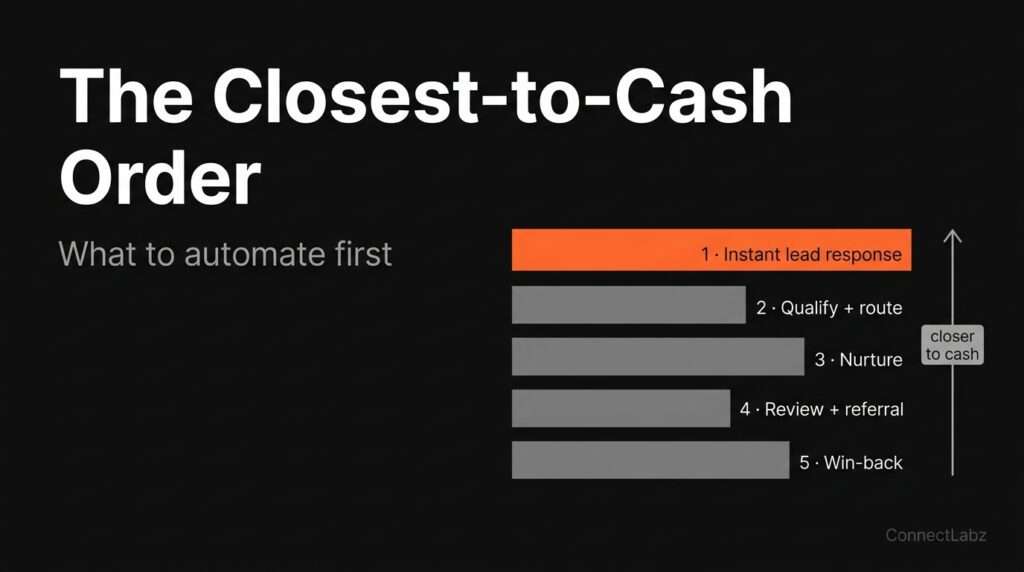
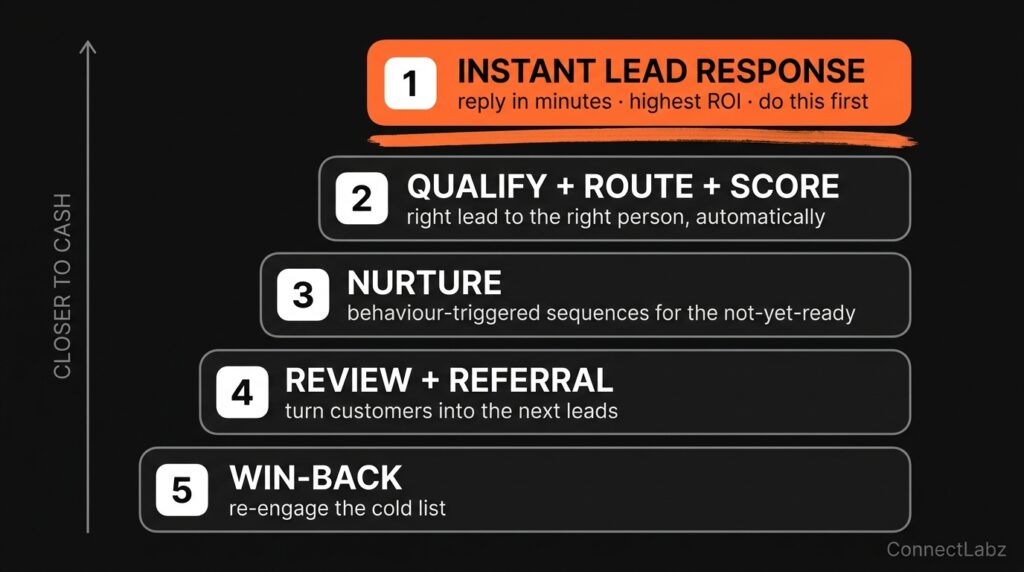
Automate in order of proximity to revenue. We call it the Closest-to-Cash Order. It runs in five steps: instant lead response, then qualify-route-and-score, then nurture, then review-and-referral, then win-back. Most owners get this backwards. They start with a clever drip campaign — or worse, automate their internal reporting first. Useful, sure. But reporting is the automation closest to nobody’s wallet.
Step 1 — Instant lead response (the leak)
This is the one to build first, always. The whole industry quietly agrees on it. The highest-ROI automation in any business is responding to a new lead the moment it arrives. It happens daily, it repeats the same steps, and it sits right on top of revenue. The mechanics are simple. A form fires an instant SMS or email that confirms you got the inquiry and sets the next step. Then your team gets pinged with full context. And where it earns its keep, an AI caller dials the lead while they’re still warm. The first 72 hours after someone opts in is the highest-engagement window there is. A short three-touch sequence across those days lifts close rates on its own. Get this one wrong, and everything downstream is just a tidier way to lose the same leads.
Steps 2 through 5 — in one breath
The rest stacks on top, in order. Qualify, route and score so the right lead reaches the right person automatically. Nurture the not-yet-ready with behaviour-triggered sequences instead of a monthly blast. Review and referral turns a closed customer into your next lead — the cheapest acquisition you’ll ever run. And win-back quietly works your cold list so it isn’t dead weight. Build them in that order and each one compounds on the last. Jump to step three first, and you’re decorating a funnel that’s leaking at the top.
Why speed to lead decides whether any of it pays off
Because the deal is won or lost in the minutes after the inquiry, not the days. The MIT/InsideSales Lead Response Management Study analysed 15,000+ leads and over 100,000 calls. It found a lead contacted within five minutes is about 21 times more likely to qualify than one contacted at thirty. The odds drop fourfold between just five and ten minutes. Yet most businesses don’t come close. In fact, a RevenueHero study of 1,000+ companies put the average first response at over 29 hours — and found 63.5% never respond at all.
More tools, slower replies
Now the part that should bother every owner who’s been told to “just buy a tool.” More software has made this worse, not better. The share of companies that never respond to a lead climbed from 23% in 2011 to 63.5% in 2024. A decade of new platforms, and the follow-up got slower. In short, the bottleneck was never tool availability. Instead, it’s an owned process, real speed, and someone (or something) accountable for the first reply.
The 2026 Blazeo benchmark makes the fix concrete. Teams using automation hit a sub-15-minute response 62.5% of the time, versus 39.1% for manual teams. And 81.2% of slow responders — over an hour — report losing leads to faster rivals. This is also why the leads your paid channels generate are only half the job. A Facebook ads agency can fill the top of the funnel all day. But if the reply is slow, you’ve bought clicks, not customers.
Software, an agency, or DIY — and what it costs in 2026
Software and an agency are two different purchases, and confusing them wastes budgets. After all, software is just the engine. An agency is what designs and drives it. In rough 2026 numbers: marketing automation software runs from free starter tools to $1,250–$15,000+ a month for enterprise suites, with lean all-in-one platforms around $100–$300. A marketing automation agency retainer is separate — commonly $2,500 to $8,000 a month, plus a one-time build. Those are directional bands from current pricing guides, not a quote.
Which one is actually for you
- DIY works when you have a little time and one clear workflow to build — usually instant lead response. A flat-rate tool plus an afternoon can get step one live.
- An agency earns its fee when your stack spans several tools, leads are leaking, or you can’t maintain the system in-house. You’re paying for the design and upkeep, not a login.
- A big enterprise suite or a $30,000 migration is something most small businesses do not need. That’s a line item for a database problem, not a follow-up problem.
The honest small-business read: don’t shop for the most expensive platform. Instead, install step one of the Closest-to-Cash Order, measure the leads it recovers, and let that ROI fund the rest. So value the recovered revenue, not the sticker price. (In India, SMB builds and retainers commonly start in the low tens of thousands of rupees a month. Treat any specific local figure as something to confirm, not gospel.)
When you do NOT need a marketing automation agency
Skip the agency, for now, if any of these are true. Maybe you only get a handful of leads a week, and a five-minute phone habit covers it. Or you don’t yet have a clear offer, a CRM, or working tracking — so automating on top of that just helps you lose faster. Some owners buy a tool and never configure it. Others just want a magic button instead of a process they’re willing to feed. And there’s a contrarian rule worth taping to your monitor: automate the leak before you pay for another channel. Pouring more traffic into a leaky funnel just wastes money faster. A quick audit will show you where yours is leaking before you spend another rupee or dollar on ads.
How do I choose a marketing automation agency?
Choose on a few things. Whether they design the system around your revenue, starting with lead response. Who owns the account and the data. How they measure success. And whether they hand you something you actually own. The polished sales deck matters far less than the answers to a few pointed questions.
- What would you automate first for us, and why? If the answer isn’t lead response (or close to it), they’re optimizing for the wrong thing.
- Do I own the CRM, the data, and the workflows? You should. A good agency builds in your house, not theirs.
- What do you report on? Pipeline and conversion by source is the right answer; opens and clicks is the wrong one.
- Is there a lock-in? Month-to-month signals confidence; a long contract signals they expect you to want out.
How long does it take to set up marketing automation?
A single high-value workflow — instant lead response — can go live in days, sometimes a single afternoon. A full Closest-to-Cash build covers qualification, nurture, scoring, and reporting. That usually takes four to eight weeks. It depends on how many tools you’re stitching together and how clean your data is. Start with step one regardless. It’s the piece that tends to pay for the rest inside the first month.
FAQ
What’s the difference between marketing automation software and an agency?
Software is the platform that runs the workflows; an agency designs, builds, and manages those workflows for you. The software is a cost whether or not it’s set up well — the agency is what makes it actually generate revenue. Many businesses pay for a tool they never properly configured; that’s the gap an agency fills.
What should a small business automate first?
Instant lead response. It’s the highest-ROI automation because it happens daily, repeats the same steps, and sits closest to revenue. First, set up an immediate reply to every inquiry. Then route it to the right person. Finally, add an AI or human call while the lead is warm — before you build any nurture sequence.
How much does a marketing automation agency cost?
In 2026, agency retainers commonly run $2,500–$8,000 per month, with enterprise programs higher and a one-time build often billed separately. That’s on top of the software itself (free to $15,000+/month). These are directional bands. Your tools, data, and scope decide where you land — so price the recovered-lead ROI, not just the fee.
Do I need an agency, or can I do it myself?
You can do it yourself if you have the time and one clear workflow to build. Bring in an agency when your stack spans multiple tools, leads are leaking, or you can’t maintain the system in-house. The test isn’t ambition — it’s whether the follow-up actually runs without you.
How fast should I respond to a new lead?
Under five minutes. A lead contacted that fast is roughly 21 times more likely to qualify than one contacted at thirty (MIT/InsideSales). More than three-quarters of buyers go with whoever responds first. If you can’t guarantee that speed manually, automation and AI calling are how you hit it around the clock.
The real decision
Marketing automation was never really a software purchase. It’s a sequencing decision — automate nearest the money first. And the money is leaking out of the gap between a lead raising their hand and your business answering. Close that gap, and the rest of the system finally has something worth compounding. The question that’s left is uncomfortable and specific. How many of the leads you paid for last month never got a fast reply? And most owners don’t know the number. That not-knowing, of course, is the expensive part.
If you’d rather have that whole system built for you — instant lead response, AI calling, and the nurture that follows — see whether we’re a fit. Apply to work with us. We’ll tell you honestly where your funnel is leaking, and whether automation is your highest-leverage next move or whether one simple fix gets you most of the way first.

