 Skip to content
By the ConnectLabz team — we run done-for-you Facebook and Instagram ad systems (creative, lead-response automation, and AI calling) for small and growing businesses. Updated June 2026.
Most owners come to us with the same knot in their stomach. They’ve just been quoted $2,000 a month by a Facebook ads agency. That fee sits on top of whatever they spend on the ads themselves. And they have no real way to know if the price is fair, or if the money is about to quietly disappear. I get the worry. “We’ll run your ads” is a sentence that hides almost everything that matters. Run them how? Make the ads, or just push the buttons? And what happens to a lead after someone actually clicks?
Consider this the breakdown I wish every one of those owners had before they signed anything: what the work really involves, what it costs in 2026, and when not hiring an agency is the smarter call.
Key Takeaways
- A Facebook ads agency does three jobs — the media buy, the creative, and the lead follow-up. The cheap ones do only the first, which is exactly why they disappoint.
- Fees sit on top of your ad spend: typically a flat $500–$5,000+/month, 10–20% of spend, or a hybrid — with setup and creative usually billed extra. (2026 figures, and they vary.)
- Below roughly $5,000/month in ad spend, an agency usually isn’t worth it. The fee eats too much of the budget; DIY or a one-time consultant wins the math.
- What decides results in 2026 isn’t targeting — Meta’s automation runs the buy now. It’s the creative you own and how fast you answer the lead.
- End the call if you hear guaranteed ROAS, “we’ll own your ad account,” no creative service, a locked annual contract, or a team you’re not allowed to meet.
What does a Facebook ads agency actually do?
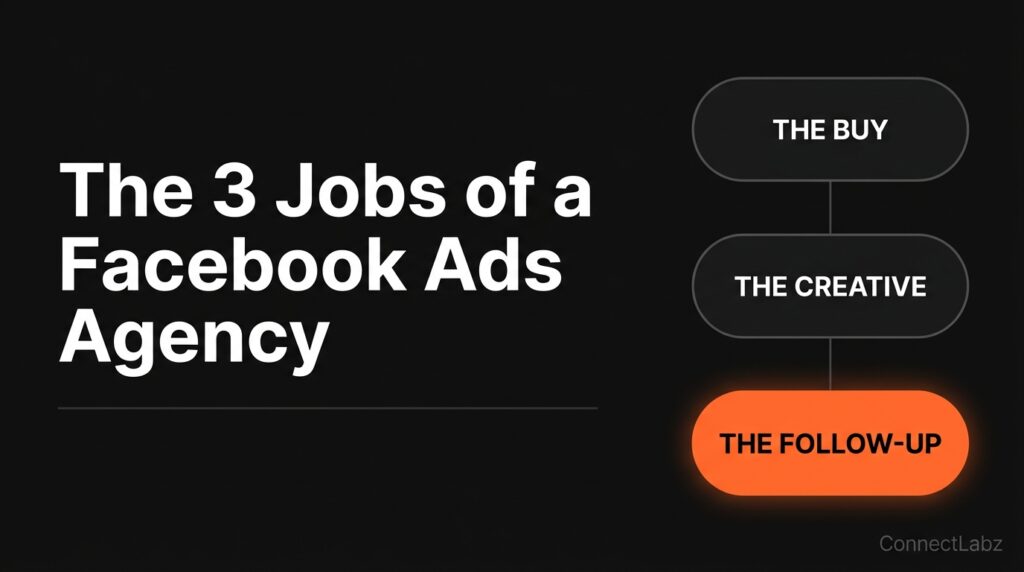
A Facebook ads agency plans, builds, and manages your paid campaigns across Facebook and Instagram — but the good ones do three jobs, not one. Most owners picture a single task: someone logs in and “runs the ads.” That picture is where a lot of money quietly goes to die. Think of it instead as the Three Jobs of a Facebook Ads Agency — the buy, the creative you own, and the lead you don’t drop. A button-clicker does the first. A real partner does all three.
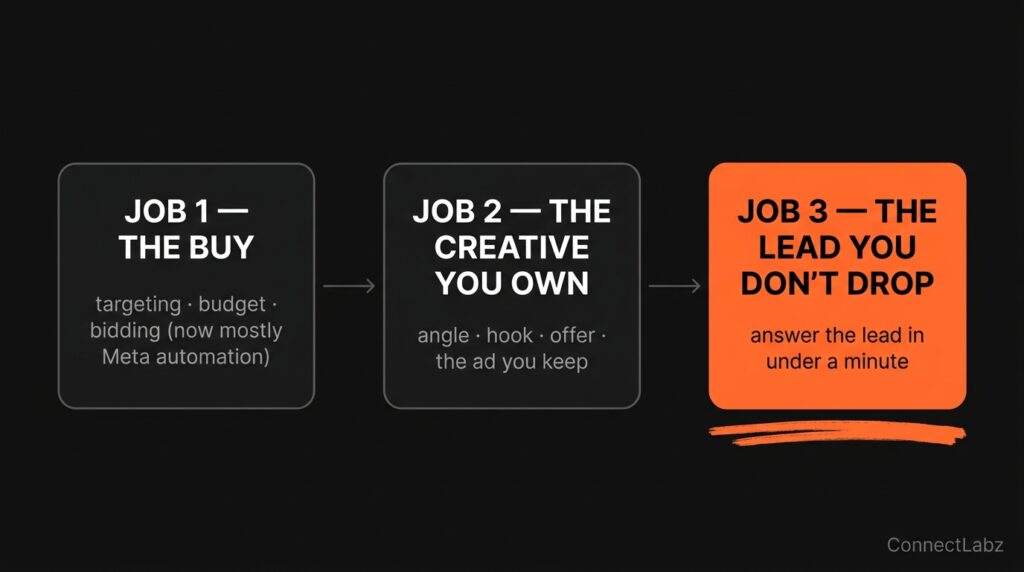
Job 1 — The buy
This is the media buying: audiences, budgets, bidding, placements, and the testing structure underneath them. It used to be the whole game. It isn’t anymore. Meta’s own automation — Advantage+ — now handles most of the targeting and budget calls a junior buyer once made by hand. That shift is a big part of how AI rewired every stage of a Facebook ad. The buy still matters. A clumsy account structure burns money fast. But it’s table stakes now, not a moat. Any agency selling “expert targeting” as its headline value is pricing a 2018 skill.
Job 2 — The creative you own
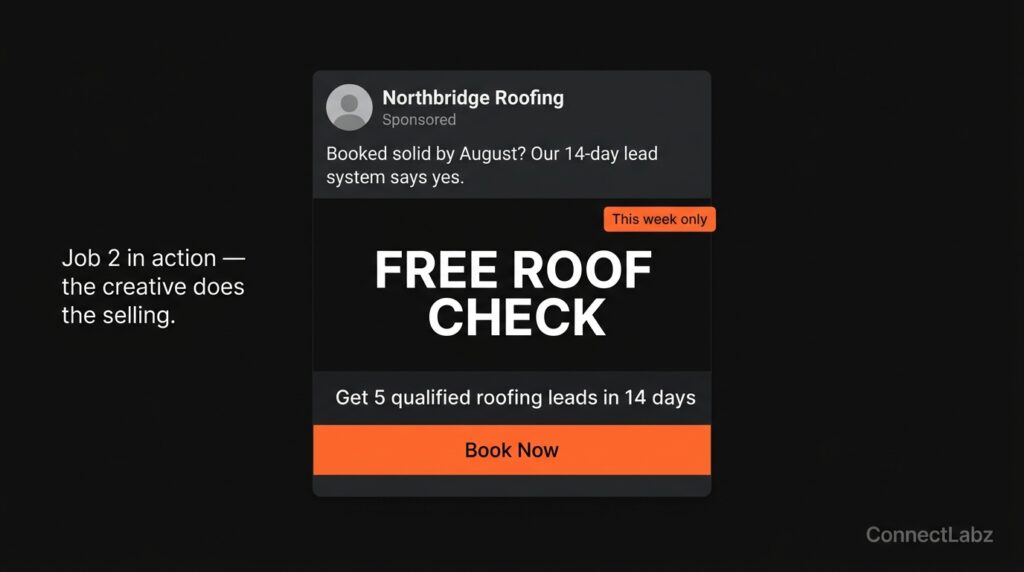
The lever that actually moves performance in 2026 is the angle, the hook, the offer, and the ad itself. One independent agency review put it bluntly. An agency that refuses to touch your ad creative is “selling you nothing.” When Meta’s machine runs the buy, the only input left in your control is what the ad says and shows. That’s the creative your business should own — produced, tested, and kept, not rented. Ask any agency what they’d make this month. You’ll learn in thirty seconds whether they do this job, or quietly outsource it back to you.
Job 3 — The lead you don’t drop
This is the job almost nobody talks about in the agency-buying conversation. It’s also the one that decides whether the spend pays off. An ad’s work ends at the click. After that, the money is won or lost in minutes. A classic Harvard Business Review study still holds up here. Firms that contact a web lead within five minutes are far more likely to qualify it than those who wait even thirty. The headline number was roughly 100 times. Most agencies hand you leads and walk away. A few — the ones built like ConnectLabz — wire up the follow-up so every lead gets answered in under a minute. That’s automation plus, where it counts, a real human or an AI caller. Generate demand, then drop it on the floor, and you’ve paid for a click and nothing else.
How much does a Facebook ads agency cost in 2026?
A Facebook ads agency fee is separate from your ad spend. It usually lands in one of three shapes: a flat retainer of about $500–$5,000+ per month, 10–20% of your ad spend, or a hybrid base fee plus a percentage. On top of that, expect onboarding and creative production to cost extra. Those are directional 2026 bands, not a quote — though multiple independent pricing guides converge on them.
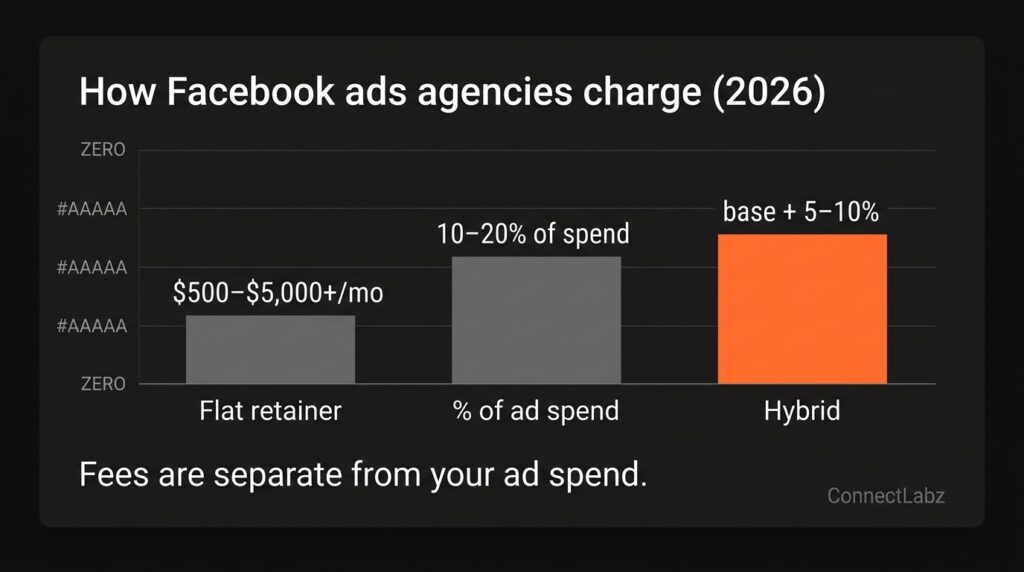
The three pricing models
A flat retainer is predictable: you pay the same fee whether you spend $3,000 or $8,000. A percentage of ad spend model (commonly 10–20%) scales with your budget. But it carries a built-in catch — an agency paid more when you spend more has a quiet incentive to push you to spend more. The hybrid splits the difference: a lower base plus a small percentage. None is “best.” Predictable budget favours the retainer; rapid scaling sometimes favours the percentage. What matters is that you can see exactly what you pay and what you get.
The hidden fees nobody mentions on the call
Three costs tend to appear after the handshake. A one-time onboarding or setup fee, often $1,000–$3,000, for the account audit and build. Creative production, billed separately — often the biggest surprise. Fresh ads every couple of weeks aren’t optional in 2026. And termination penalties buried in a locked annual contract. Ask about all three before you sign, not after.
The math that actually decides it: fee-to-spend
Here’s the number most owners never run. Divide the management fee by your ad spend. At $1,000/month in spend with a $1,500 retainer, you’re paying 150% of your budget in fees before Meta shows a single ad. The work simply can’t pay off. That’s why most reputable agencies want a minimum spend (often $1,000–$3,000+/month) before they’ll take you on. (In India, SMB management retainers commonly start in the low tens of thousands of rupees a month. Treat any specific local band as something to confirm, not gospel.)
Is a Facebook ads agency worth it for a small business?
Yes — but only past a threshold. A Facebook ads agency is usually worth it once you’re spending around $5,000/month or more. The other trigger is needing creative volume and follow-up speed you can’t build alone. Below that, the fees consume the budget. You’re better off doing it yourself, or hiring a consultant for a one-time setup. The honest answer depends less on your ambition and more on your math.
When an agency is the right call
Three situations make the spend rational. You’re spending enough that a 15% fee buys senior attention and still leaves a working budget. You need a steady stream of new ad variations — the kind of creative velocity one in-house generalist can’t sustain. Or you want all three jobs under one roof, so demand generation and follow-up stop living in different buildings. If two of those three are true for you, an agency stops being a cost and starts being leverage.
When you should NOT hire a Facebook ads agency
Skip the agency — for now — if any of these fit. Your ad spend is under about $5,000/month and the fee would swallow it. You don’t yet have a clear offer, a landing page that converts, or working tracking. An agency pouring traffic onto a broken funnel just helps you lose money faster. You’re hoping someone will guarantee results. Or you’re unwilling to feed the creative with real input about your business. And one contrarian truth worth sitting with: fix your follow-up speed before you pay anyone to send you more leads. More leads into a slow funnel just means more leads wasted, faster. If your follow-up is broken, that’s the cheaper fix. Start there — a quick audit will show you where the leak is.
Facebook ads agency vs freelancer vs in-house vs DIY
The right model tracks your spend and your bandwidth, not your ego. Under ~$5,000/month, do it yourself or hire a consultant for a one-time setup. Between ~$5,000 and ~$15,000, a senior freelancer or fractional specialist often beats a full agency on value. Above ~$15,000 and growing, an agency earns its fee. That’s also true when you need creative volume and follow-up no single person can run. Build an in-house team only when blended spend is high enough to fund a specialist plus a creative pod.
- DIY / consultant — best under $5k/month. Cheapest, most educational; a one-time setup plus your own hands beats a thin retainer.
- Senior freelancer — the sweet spot for many $5k–$15k accounts: senior judgment, single point of contact, no agency overhead.
- Agency — earns it above ~$15k/month or whenever you need all three jobs owned and creative produced at volume.
- In-house — only once the spend funds a buyer and a creative team. Otherwise you’ve bought a single point of failure.
The axis that actually separates these isn’t price. It’s whether creative and follow-up get owned, or quietly left to you.
How do I choose the right agency (and spot a bad one)?
Choose on a few things, not on price or promises. Whether they own the creative and the follow-up. Who runs your account day-to-day. And how they handle the gap between what Meta reports and what your CRM shows. The polished person on the sales call is rarely the person who’ll manage your money. Your job in the meeting is to find out who is, and how they think.
The questions that expose a B-team
- Who runs my account day-to-day, and can I meet them before I sign? The A-team-to-B-team switch is the most common bait-and-switch in the industry.
- Show me your creative testing framework — not your portfolio. You want a process, not a highlight reel.
- When Meta says 100 conversions and my CRM shows 60, what do you do? A senior operator has a real answer about attribution; a junior one changes the subject.
- Can I talk to two current clients with budgets like mine? A confident agency says yes.
The red flags that should end the call
- Guaranteed ROAS or “only pay if we perform.” It signals a fantasy or a junior team. Performance depends on your offer and margins — which they don’t control.
- “We’ll own your ad account.” You own your ad account and Business Manager. Always. Renting your own growth is how businesses get held hostage.
- No creative service. In 2026 that’s a 2018 playbook.
- A locked annual contract. If they need to trap you, they already doubt the work will hold you.
How long until the ads start working?
Expect roughly two to four weeks for campaigns to exit Meta’s learning phase and produce a first signal. Then about 60–90 days for a fair read on real performance. Anyone promising profitable returns in week one is selling, not forecasting. The first fortnight is data collection; the honest agencies tell you that up front instead of faking a fast win.
FAQ
Do I pay the agency’s fee on top of my ad spend?
Yes. The management fee and your Meta ad budget are always separate. A “$2,000/month” agency means $2,000 to them plus whatever you spend on ads. Confirm this in writing before you sign — it’s the single most common misunderstanding.
What’s the minimum budget to make a Facebook ads agency worth it?
Around $5,000/month in ad spend is the rough line where a Facebook ads agency starts to make financial sense. Below that, fees eat too much of the budget to leave room for results. If you’re under it, hire a consultant for a one-time setup, or fix creative and follow-up first.
Should the agency or I own the ad account?
You should — always. Your ad account and Business Manager belong to you, and a good agency simply gets access. If a prospective agency wants to build the account under its own Business Manager and won’t transfer it, treat that as a deal-ender.
Is “pay only if we perform” pricing a good thing?
Usually it’s a red flag. Genuine performance depends on your offer, pricing, and margins — things the agency doesn’t control. So a real guarantee is either unrealistic or hiding a junior team. Aligned incentives are good; magic promises are not.
Can a small business afford to hire an agency?
Sometimes — at the right fee-to-spend ratio. Packages exist for smaller budgets, but make sure the fee leaves enough spend to generate returns. If it doesn’t, the higher-leverage move is often to fix your ad creative and follow-up first. Then bring in an agency once the spend justifies it.
The real decision
The choice was never really about price. It’s about which of the three jobs get owned — the buy, the creative, and the follow-up. And how many of them you can run well on your own. Meta’s automation closed most of the gap on the buy. So the question that’s left is sharper and more personal. Where is your funnel actually leaking — the creative, or the follow-up after the click? Most owners don’t know, and that’s the expensive part.
If you’d rather have all three jobs under one roof — the ads, the creative you keep, and a follow-up system that answers every lead fast — see whether we’re a fit. Apply to work with us. We’ll tell you honestly whether an agency is even your highest-leverage next step, or whether you’re better off fixing one thing first.

